Loading article

Cookie preferences
We use strictly necessary storage for site operation and optional categories for experience, measurement, and marketing. Choose what Gelectric can use, and update it any time from Cookie Settings in the footer.
Cookie preferences
We use strictly necessary storage for site operation and optional categories for experience, measurement, and marketing. Choose what Gelectric can use, and update it any time from Cookie Settings in the footer.

Gelectric Editorial Team

This document outlines the Automated Compliance Reporting solution developed by Gelectric. The primary objective of this solution is to streamline the complex reporting requirements for EU ETS, IMO DCS, and EU MRV. By utilizing the Automated Data Catcher, we transform unstructured vessel data into verified, audit-ready datasets, ensuring that shipping companies meet their environmental obligations accurately and on time.
The maritime industry is facing a new era of environmental accountability. Regulations such as the EU Emissions Trading System (ETS) and the FuelEU Maritime initiative require vessel operators to report precise emissions data. Historically, this has been a manual, fragmented process involving the collection of paper-based bunker delivery notes and manual noon reports. As carbon emissions now carry a direct financial cost in the form of EU Allowances (EUAs), the margin for error in reporting has disappeared.
The primary challenges identified in regulatory compliance reporting include:
Receive our monthly maritime intelligence report directly in your inbox.
Expand your knowledge with these recent publications.

When the International Maritime Organization (IMO) introduced the Energy Efficiency Existing Ship Index (EEXI), shipowners faced a strict mandate: establish a technical design benchmark to ensure existing vessels meet carbon intensity...
The primary objectives of this solution:
To address the identified problems, Gelectric provides a dedicated compliance layer within the automated data pipeline:
Port-to-Port Voyage Details Extracting arrival/departure times, berth stay durations, and cargo quantities. Source: Arrival/Departure Reports & Port Log PDFs.
Fuel-Specific Emission Profiles Differentiating between HFO, LFO, and Biofuels to apply correct emission multipliers. Source: Bunker Delivery Notes (BDNs).
Transport Work Metrics Calculating "Cargo Handled" vs. "Distance Traveled" to fulfill MRV efficiency reporting requirements. Source: Cargo Manifests & Noon Reports.
Onshore Power Supply (OPS) Usage Tracking time connected to shore power to reduce taxable emissions under FuelEU Maritime. Source: Technical Logs & Engine Room PDFs.
Following the activation of the Automated Data Catcher, the compliance team gains access to a pre-verification dashboard:
The Gelectric Automated Data Catcher removes the friction and risk from maritime compliance. By automating the data journey from the vessel’s deck to the regulator’s desk, we ensure that compliance is a byproduct of efficient operations rather than a manual chore. In an era where "data is currency," our solution ensures your emissions reporting is as precise as your financial accounting.
To learn more or request demo:
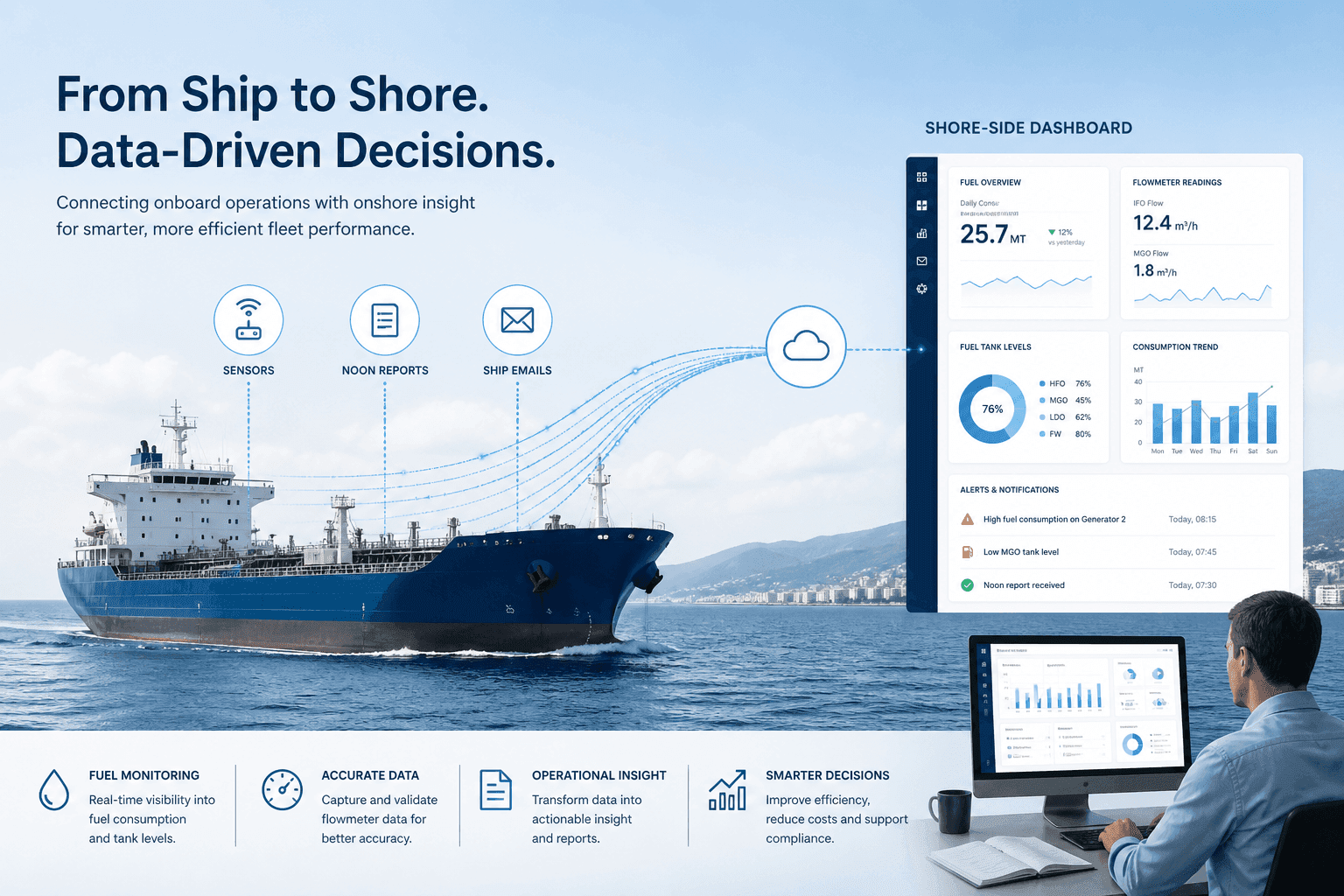
In many fleets, digital flowmeters are already installed on board. But in practice, the data is often still checked locally on the vessel, used only for limited reporting purposes, or reviewed after the fact. As EU MRV requirements continue...

Meeting regulatory demands in the maritime industry is no small feat. As shipowners and fleet managers, you face increasing pressure to comply with environmental standards while maintaining operational efficiency. The EU Monitoring,...